
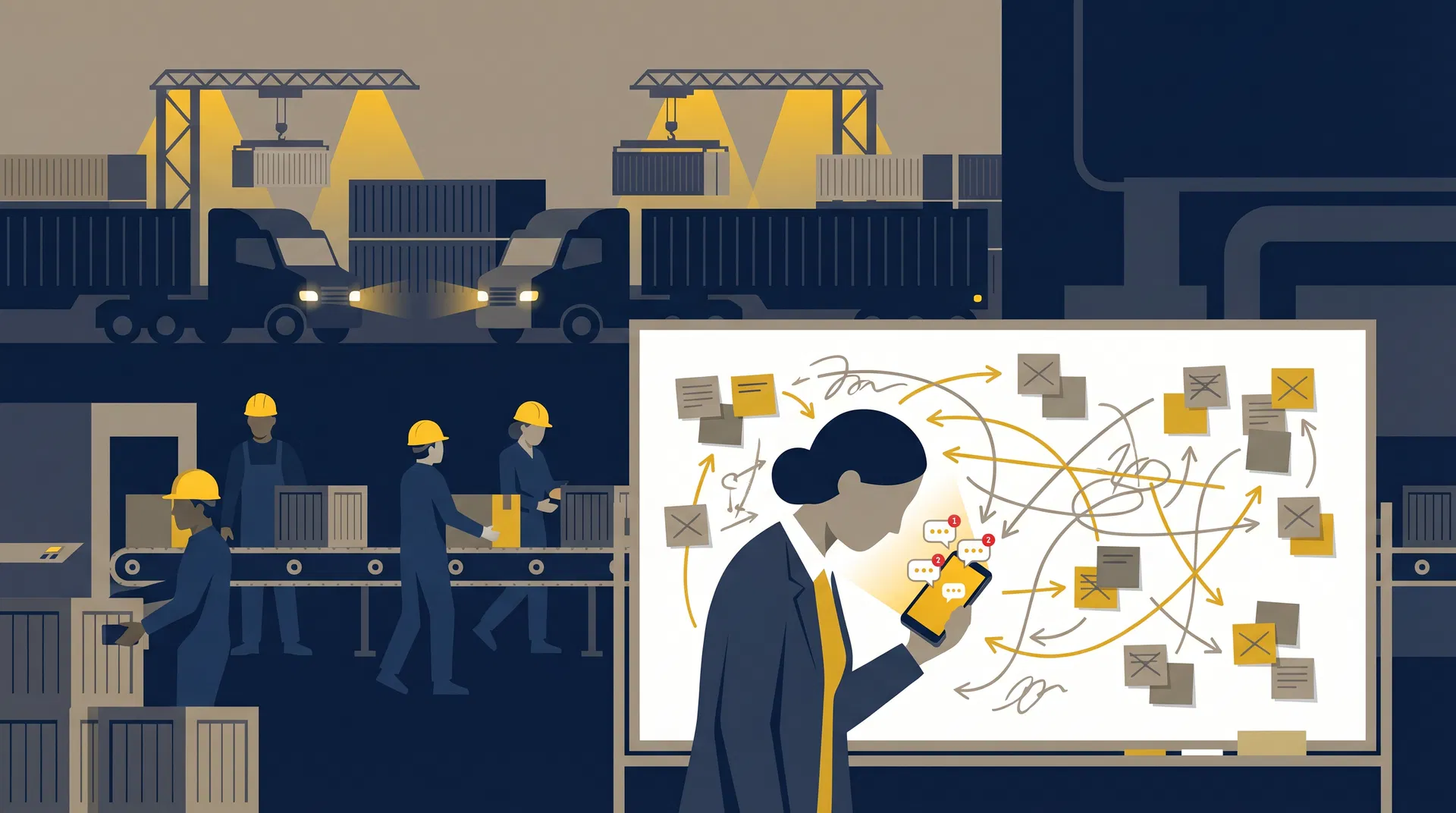
If you run a manufacturing or logistics business in South Africa, you know what growth looks like. It looks like more trucks in the yard. It looks like more shifts on the floor. It looks like more revenue on the income statement.
But if you look closely, you will see what growth feels like when your systems have not kept pace. It feels like chaos.
It feels like the operations manager spending three hours a day chasing status updates on WhatsApp. It feels like losing a job because the quote went out late. It feels like re-planning the entire production schedule on a whiteboard because Eskom moved us to Stage 4.
You are winning new clients, but the chaos behind the scenes is starting to cost you.
The Cost of the "WhatsApp Workflow"
When a business starts out, informal systems work. You tell the foreman what to build. You WhatsApp the driver the delivery address. You keep the stock count in your head.
But when you hit 20, 50, or 80 staff, those informal systems break. The "WhatsApp Workflow" becomes a liability.
Here is what happens when your business outgrows its infrastructure:
The time leaks multiply. Your best people stop doing the work you hired them for. Instead, they become human routers. They copy data from an email into a spreadsheet. They copy data from the spreadsheet into a WhatsApp message. They copy the WhatsApp reply back into the accounting software. This is not work. This is waste.
The errors get expensive. When data lives in three different places, mistakes happen. The wrong material gets ordered. The wrong address gets dispatched. The invoice goes out for the wrong amount. You only find out when the client complains.
The owner becomes the bottleneck. If every exception, every delay, and every question requires your approval, you are no longer running a business. You are running a dependency. When you are firefighting, you do not have the bandwidth to pursue new clients or improve your margins. Growth potential gets sacrificed on the altar of managing today's chaos.
What the Fix Actually Looks Like
The good news is that you do not need an enterprise ERP system with a six-figure implementation budget and a six-month rollout. Most growing South African SMEs need three things, connected properly, and configured for how they actually work.
A central job management system. Every order that comes in needs to live in one place. Not in an inbox. Not in a WhatsApp thread. Not on a clipboard. A simple job management system gives every job a record: who ordered it, what was agreed, the deadline, the stage, and the owner. When a customer calls, anyone in the business can pull up that information in under thirty seconds. No searching. No guessing.
A visual production schedule. Knowing what jobs exist is the first step. Knowing how to sequence them is the next. A digital production schedule gives your team a shared view of reality that a whiteboard simply cannot provide. It moves jobs through clear stages: Quoted, Confirmed, In Production, Quality Check, Ready for Delivery, Invoiced.
Structured communication. The problem with WhatsApp is not communication itself. It is that the communication is disconnected from the actual jobs. When a message about Job #247 lives in a general group chat, it gets buried. When that same message lives inside Job #247's record, it is permanently accessible and searchable. Tools that keep communication job-specific eliminate the endless scrolling problem entirely.
These three components do not need to be exotic. The key is configuration. You must set up the system to match your specific workflow, rather than forcing your workflow to match a generic template.
The Role of AI in Getting You There Faster
Where AI integration adds particular value is not in replacing your team. It is in collapsing the time and effort required to build and run these systems.
AI can automatically capture and log incoming orders from email or WhatsApp into your job management system, without manual data entry. It can flag jobs that are approaching their deadlines. It can generate customer update messages based on job status, so your team spends less time writing repetitive emails.
It can surface patterns in your data. Which job types take longer than quoted? Which customers generate the most admin? Which periods of the month create capacity crunches? AI gives you the visibility to make better decisions about pricing, capacity, and planning.
None of this requires a technology degree to benefit from. It requires the right setup, the right guidance, and a willingness to commit to working in the system rather than around it.
The Right Time to Fix This Is Before the Breaking Point
Most business owners wait too long. They tolerate the chaos because the business is still growing, because customers are mostly happy, and because the team is managing just barely. They tell themselves they will sort the systems out when things quiet down.
Things do not quiet down. And the longer you wait, the more deeply the informal habits become embedded, and the harder they are to change.
The businesses that scale successfully are not the ones that had perfect systems from day one. They are the ones that recognised the gap early, took it seriously, and invested in closing it before it became a crisis.
If your business is growing faster than your systems can handle, the gap is already there. The question is whether you close it deliberately, or let your customers close it for you.
Aitsa AI Consulting helps South African SMEs build operational systems that match their growth. If your manufacturing or logistics business is showing signs of outgrowing its infrastructure, book a Free AI Assessment [blocked] or explore our Quick Win Sprints [blocked]. We will identify exactly where your time leaks are and what it takes to close them.
Aitsa! Stop Managing. Start Growing.